
Which digital tools from the Grenoble academy truly allow for structuring an annual program in 2026-2027, and how do they differ from generic teaching organization solutions? The academy covers five departments (Ardèche, Drôme, Isère, Savoie, Haute-Savoie) and offers disciplinary resources produced by internal working groups. Comparing these academic resources to traditional planning tools helps identify what should be integrated right from the start of the school year.
Academic resources in Grenoble and generic tools: comparative table
Teachers have two families of tools to prepare for their 2026 school year. On one side, the resources specific to the Grenoble academy, accessible via disciplinary portals. On the other, generic planning agendas and software.
| Criterion | Grenoble academy resources | Generic tools (agendas, software) |
|---|---|---|
| Type of content | Disciplinary sequences, AI experiments, interlanguage resources | Weekly schedules, grade tracking, course organizer |
| Pedagogical customization | Adapted to programs and local experiments (cycle 3, modern languages) | Empty structure to be filled by the teacher |
| Update | Produced by academic working groups (teachers, trainers, inspectors) | Annual update of the school calendar only |
| Format | Online digital resources | Paper (A4) or web application |
| Cost | Free, access via academic portal | Variable depending on the publisher |
The main difference lies in the nature of the content. A planning agenda structures time, while academic resources directly feed into the programming of sequences. The two do not exclude each other, but academic resources fill a need that agendas do not cover: the pedagogical content itself.
To organize your school year with Grenoble convergence, you first need to locate the disciplinary portals of the academy before choosing a planning tool.

AI experiments in the Grenoble academy: what it changes for programming in 2026
The Grenoble academy does not limit itself to disseminating calendars. AI experiments are scheduled to begin in January 2026 for cycle 3, particularly in Savoie. Six services are being tested in French, mathematics, and modern languages, as part of the Partnership for Innovation in Artificial Intelligence (P2IA).
These tools aim for personalized learning and student tracking, without replacing the teacher. Specifically, this means that a cycle 3 teacher in the academy can integrate these devices into their annual programming starting in the second term.
Concrete example in modern languages
The interlanguage digital working group of the academy has published a resource using LlaMagen.ai to work on written expression using AI-generated comics. This type of ready-to-use sequence can be inserted into an annual progression without a lengthy design phase.
Searching for resources from academic disciplinary groups before building your sequences reduces preparation time. A modern languages teacher consulting the academy’s English-pedagogy portal finds sequences tested by peers and validated by inspectors.
School calendar 2026-2027 zone A: key points for structuring the year
The Grenoble academy falls under zone A. The division of the year into periods conditions the programming of sequences and evaluations. Three points deserve attention for planning:
- The start of September 2026 sets the starting point for progression. The first weeks are used to adjust the sequences prepared during the summer, not to build them from scratch.
- The All Saints’ Day holidays in 2026 mark the end of the first period. Placing an interim assessment before this break allows for reorienting the programming for the second term.
- With P2IA experiments starting in January 2026, the return from the end-of-year holidays is the time to integrate AI tools into the cycle 3 progression.
Anticipating these milestones as early as June or July, during the end-of-year audit, avoids last-minute adjustments in September. The idea is not to plan everything in detail, but to lay out the main sequences on a calendar and reserve slots for the identified academic resources.
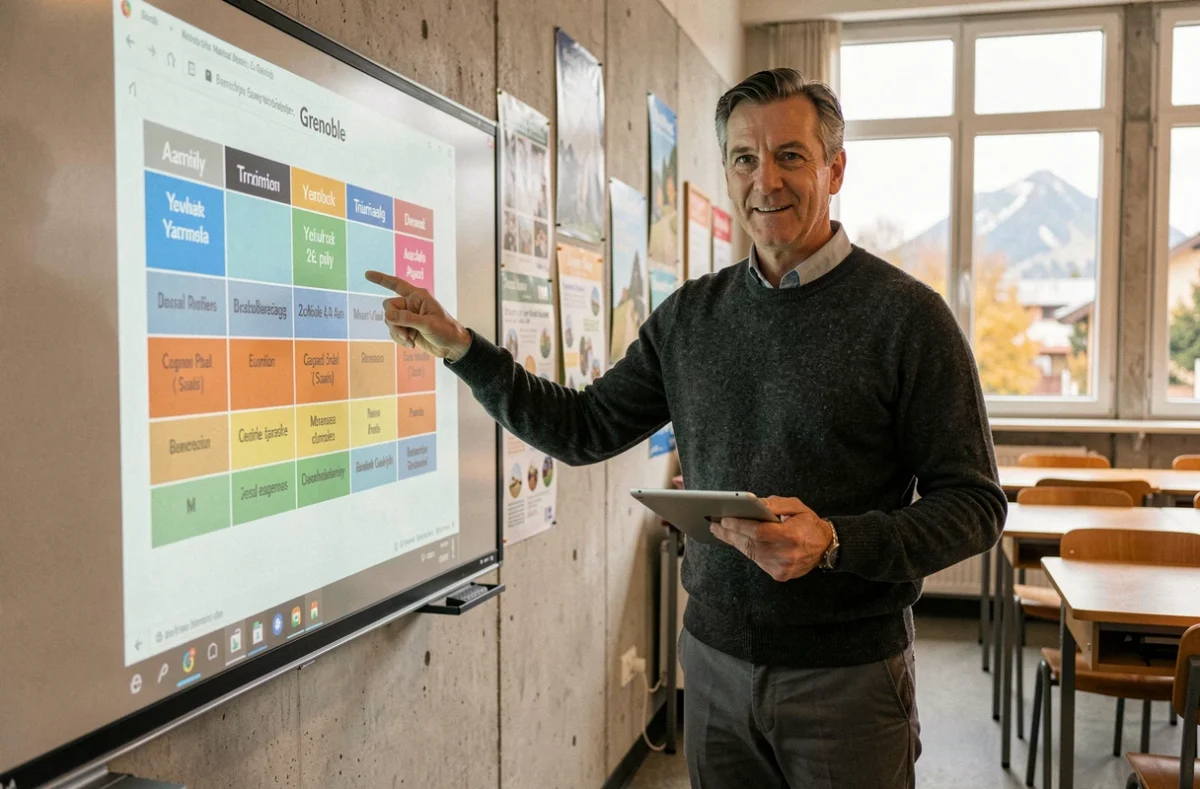
Disciplinary portals of the Grenoble academy: where to find sequences by subject
The convergence towards the digital services of the academy requires knowing where to look. The Grenoble academy organizes its resources by discipline, each having a dedicated subdomain (english-pedagogy, savoie-educ for digital in Savoie, etc.).
The resources are produced by field personnel, gathered in working groups composed of teachers, trainers, and inspectors. This functioning ensures a grounding in the reality of classrooms, unlike a generic organizational guide.
What to check before the start of the school year
- Access the disciplinary portal corresponding to your subject on the Grenoble academy website.
- Identify the sequences published or updated for 2026-2027, particularly those integrating AI experiments in cycle 3.
- Check if any academic training or webinars are scheduled between September and December 2026.
- Archive your own sequences from 2025-2026 to compare them with the new resources available.
This process takes less than an hour and allows you to distinguish what can be reused from what needs to be rebuilt. The audit of your own sequences combined with academic resources forms the basis of a realistic programming.
Organizing a school year is not just about choosing an agenda or a blank planning sheet. For teachers in the Grenoble academy, disciplinary portals and P2IA experiments represent an underutilized preparation lever. Consulting these resources before finalizing your annual progression saves time on design and aligns your sequences with current academic orientations.